

What Are The Animals That Are Going Extinct
Extinction is a natural part of any species' timeline on Globe. The nature of development is that the species with the about valuable advantages is ordinarily the species most likely to survive. That means, of grade, that many species fail to thrive and naturally go extinct. In that location are also animals that accept gone extinct due to deforestation.
But in that location have been 5 mass extinction events on Earth, and some scientists believe that we're currently in the middle of the 6th. In fact, one contempo study concluded that three-quarters of the animate being species currently living on World could be extinct in the next 300 years.
The about tragic part is that this result is entirely human-acquired. From habitat devastation in the form of deforestation to the introduction of invasive predators and diseases, humans are the biggest threat to any animal species. But that means we likewise take the power to save them.
Defining "Extinction"
The International Wedlock for Conservation of Nature (IUCN) defines a species every bit extinct when the concluding member of a species has undoubtedly died. On the surface, extinction seems like a relatively unproblematic determination. Either a species exists, or it doesn't, right?
In reality, it'southward a much more complicated and nebulous concept than you might believe at outset glance. Proving beyond a reasonable doubt that there are no living members of a species in the wild requires exhaustive surveys repeated multiple times over a period of several years at least.
Fifty-fifty then, declaring that in that location's not a single living member left is nearly impossible. Fifty-fifty if an entire species were isolated on an isle of fewer than 100 square miles (as some species are), thoroughly combing the area would have years, during which fourth dimension animals could migrate.
The result is that it takes years and sometimes even decades before scientists tin confidently say that every member of a species has died in the wild. The issue is complicated fifty-fifty further because a species extinct in the wild may continue to exist in captivity.
The Spix's Macaw, as yous'll come across, has been entirely extinct in the wild for years. However, in captivity, the species is thriving as an exotic household pet. Other species may go along to exist and even reproduce in conservation zoos long afterward their wild relatives accept gone extinct.
Until the IUCN tin can say with certainty that a species has ceased to exist in captivity, in the wild, or both, they may classify it as Critically Endangered. They may also say that a species is Possibly Extinct, a tentative subclassification that falls nether Critically Endangered.
The result is that researchers may keep to allocate a species every bit Critically Endangered after the last fellow member of the species has died. In September 2021, the United States declared 23 species extinct, including the Ivory-Billed Woodpecker, which was last seen 80 years ago.
The final member of that species almost certainly died decades ago, still it was just recently classified as extinct. This is just one of many known examples of species last seen years ago that take still to exist declared extinct. At that place are well-nigh certainly more examples than we know.
Even if a species withal has a few g members left in the wild, though, that doesn't guarantee its survival. There must be enough members of a species within a specific geographic range to reproduce faster than predators, and other threats tin crusade them to die.
In some cases, groups of animals are and then widely spread out that they don't encounter each other enough to reproduce. In others, the outside threats to the species are and so overwhelming that their extinction is inevitable.
Finally, as you lot'll see, species tin can exist brought back from extinction through captive conservation programs. These programs attempt to reintroduce a species into the wild – merely faced with the aforementioned threats that caused their extinction in the showtime place, the animals oft die.
For that reason, this list of extinct animals includes species that are definitely extinct, probably extinct, nearly extinct, and inevitably on their style to extinction because the official characterization isn't as important equally the fact that an entire species is or volition soon be lost.
See Related: Animals That Accept Become Extinct in the Concluding 100 Years
13 Animal Species That Are Extinct (or Nearly Extinct) Due to Deforestation
These thirteen animate being species are either already extinct or threatened to the point where their extinction is all but assured. For some, conservation efforts tried simply failed to save them. Others were so nearly extinct when they were discovered that they were already beyond saving.
This range of scenarios demonstrates the complexity of declaring a species extinct. It too highlights the importance of conservation efforts to prevent the ripple effect that leads a species to exist completely decimated.
The one thing that each of these species has in common is that humans are the chief threat to their being. Whether development has destroyed their habitat or the copse have been taken as bolt, deforestation is entirely a human problem.
The proficient news is that at that place are still plenty of species in beingness, and we accept the opportunity to larn from our mistakes. With the latest scientific advancements and those to come in the future, we can reduce the human impact on the animals around us.
one. Formosan Overcast Leopard (Neofelis nebulosa brachyura)
Despite its proper noun, the Formosan clouded leopard is a distant relative of other leopards. Big cats like the tiger, king of beasts, jaguar, and leopard are part of the Panthera genus, while overcast leopards make upwardly their own genus – Neofelis.
The Neofelis genus is farther subdivided into 2 species of overcast leopard.
The mainland clouded leopard, Neofelis nebulosa, occupies the Asian mainland, while the Sunda clouded leopard, Neofelis diardi, occupies the islands of Sumatra and Borneo. The Formosan Clouded Leopard was a subspecies of the Mainland Clouded Leopard only found in Taiwan.
Deforestation due to logging degraded its habitat, forcing information technology into the mountains. The last official sighting of the Formosan Clouded Leopard was in 1983, though that photo may actually have been of Neofelis diardi in Borneo.
An exhaustive survey from 2001-2004 ended that there was no prove of clouded leopards in the region, and in 2013, the Formosan overcast leopard was declared extinct. In 2019, several people reported sightings of the Formosan overcast leopard, but those have non been confirmed.
To complicate things fifty-fifty further, scientists are discussing the possibility of reintroducing clouded leopards to Taiwan. The confusing status of the Formosan overcast leopard is a perfect example of the complexities of declaring a species "extinct."
2. Paradise Parrot (Psephotellus pulcherrimus)
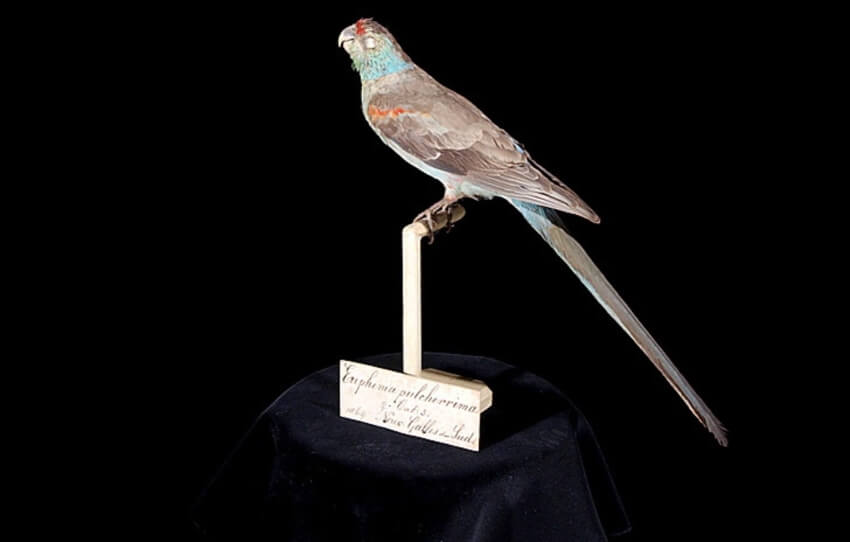
Paradise parrots were a species of parakeet native to Australia. These birds were unusually beautiful, with their tail making up nearly half of their ten-inch size. Their colorful feathers were turquoise, dark-green, orange, and brown. Paradise parrots nested in pairs, and they occasionally made small family groups in hollowed-out termite mounds.
Due to a combination of country clearing, hunting, and predation past cats introduced by humans, what was once a relatively common bird on the Australian mainland became rarer and rarer. By 1915, the species was believed to have been extinct. But on December 11, 1921, almost exactly 100 years ago, Cyril Jerrard of Gayndah, Australia, spotted a mating pair of paradise parrots.
Over the adjacent twenty years or so, there were reports of sporadic pairs of paradise parrots spotted. Though there was quite a lot of publicity around the critical condition of the birds, there were few known solutions to protect them at that fourth dimension. Sadly, the last official sighting of one alive was in 1927, and they are certainly extinct today.
three. St. Helena Darter (Sympetrum dilatatum)
The St. Helena Darter was a dragonfly species endemic to St. Helena Island, a tiny island in the middle of the Atlantic Sea between Brazil in South America and Republic of angola in Africa. It had no other known habitats prior to its extinction.
The exact cause of the extinction of the St. Helena Darter is unknown, but it was probable a combination of factors. St. Helena Island was colonized in the late 16th century, and habitat destruction from colonization was likely a primary cause of extinction. Other invasive aquatic species were as well introduced, further contributing to population loss.
The last official sighting of the St. Helena Darter was in 1963, and it was declared extinct some fourth dimension afterwards that. However, in 2011, it became apparent that there had been no comprehensive surveys of St. Helena Island since 1963, and information technology was reclassified as Data Deficient and later Critically Endangered (Perchance Extinct). Information technology was declared extinct again in 2020.
four. Hawaiian Crow (Corvus hawaiiensis)
The Hawaiian crow was once considered relatively abundant on all of the Hawaiian islands, but peculiarly in western and southeastern Hawaii. It had a telephone call that sounded a lot like a cat's meow, forth with a variety of others, and was known to utilise sticks instinctively to extract food from holes in logs.
It played a critical role in the proliferation of seeds of many native Hawaiian plants. The Hawaiian crow distributed the seeds and germinated them every bit they passed through its digestive tract. Many such plants have no other means of dispersing their seeds.
The colonization of the Hawaiian islands introduced multiple threats to the Hawaiian crow. Deforestation led to habitat loss, and the lack of tree cover exposed the birds to predators from higher up and below. Humans illegally hunted them, believing they were a threat to crops. The concluding members of the species were seen in the wild in 2002.
In that location are approximately 115 individuals in captivity. In 2016, scientists released thirty captive Hawaiian crows into the wild, hoping that the reintroduced birds would repopulate the island. Unfortunately, only five remained four years after, and they were taken dorsum into captivity to protect them. Scientists are currently re-evaluating the programme in hopes of trying again.
5. Pygmy Raccoon (Procyon pygmaeus)
The pygmy raccoon, besides known equally the Cozumel raccoon, lives just on the island of Cozumel, Mexico. They are the smallest of the Procyon genus, weighing around 7.vii pounds on average, about half the size of their nearest mainland relative, and have xanthous rings instead of black.
Though not technically however extinct, there are believed to exist only 189 adult pygmy raccoons in the wild on the entire 486 foursquare-mile island, and that number is declining. Pygmy raccoons face many threats to their survival as a species, just the most significant threat is tourist development.
Though considered critically endangered, little is being washed to protect them from non-native predators and diseases brought by invasive species. Meanwhile, every bit the tourism industry goes, more and more of their habitat is being destroyed, and they have no manner of escaping the island.
Conservationists are considering several options to save the species. Preserving the mangrove forests where the pygmy raccoons alive would halt the island'due south tourist centers from expanding further into their habitat. Conservation zoos may besides begin captive breeding programs.
Run into Related: Endangered vs Threatened vs Extinct
vi. Kāmaʻo (Myadestes myadestinus)
The Kāmaʻo, also ordinarily known equally the Large Kaua`i Thrush, lived merely on the isle from which information technology got its proper noun. They were the largest of Hawaii's native thrush species and were reddish-brown with olive-colored feathers.
In the late 1960s, at that place were believed to be effectually 350 adult Kāmaʻo on the island of Kaua`i. Sadly, humans destroyed their habitat to clear the style for farming and ranching. Deforestation combined with invasive pests and introduced predators ultimately drove them to extinction.
7. Sumatran Orangutan (Pongo abelli)
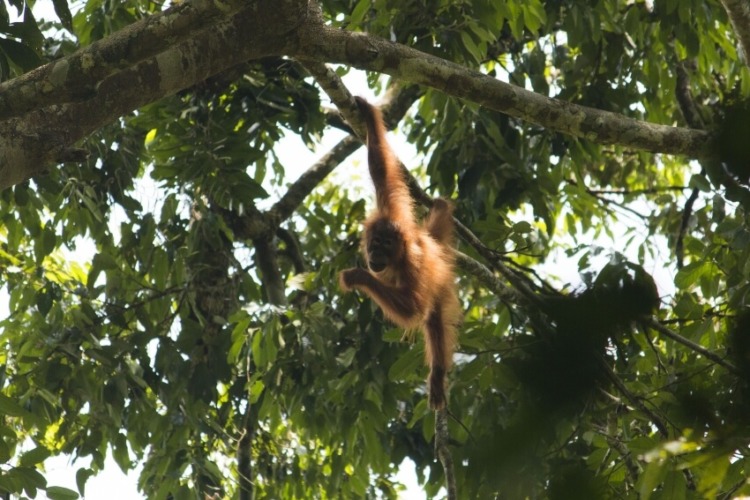
The Sumatran orangutan's geographic range is express to the mountainous forests in the northern part of the island of Sumatra, Indonesia. They're completely arboreal, living only in the trees and rarely coming to the ground, making them particularly vulnerable to deforestation.
Though their range once spread across the unabridged island, deforestation and habitat destruction take ultimately cornered the remaining Sumatran orangutans. They're critically endangered, non yet extinct, and roughly xvi,000 of them remained at the terminal survey in 2016.
Though that number sounds promising, it includes subpopulations that aren't believed to be feasible long-term. In reality, there may be merely thirteen,000 adults remaining in the wild, and that number is on the decline.
Their primary threat is habitat loss due to deforestation. Despite conservation efforts, forest fires, land clearing, timber logging, and agronomical development are driving the remaining Sumatran orangutans college and higher into the mountains.
Run into Related: Sumatran Tiger
viii. Kākāwahie (Paroreomyza flammea)
The Kākāwahie was one time owned to the isle of Moloka'i, Hawaii, but was last seen in the wild in 1963. Sadly, not much is even known nearly this bird, as it was last seen commonly in 1907 and was rare by the 1930s.
The likely causes of the kākāwahie'south extinction were habitat devastation in the form of deforestation and the introduction of diseases to which they had no resistance. Surveys since 1979 have failed to locate whatever individuals of the species, and it was alleged extinct in 1988.
The kākāwahie is a perfect example of how long it tin can accept to declare a species extinct, even when it hasn't been seen in decades. Despite final being seen in the 1960s, information technology was most 1990 before information technology was officially declared lost.
9. Darwin's Play a joke on (Lycalopex fulvipes)
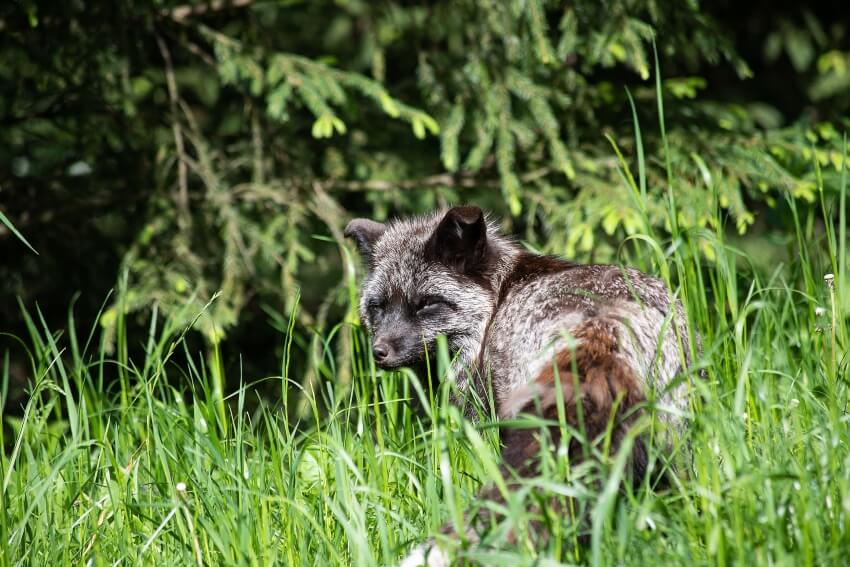
This fox species is owned to Chile. Though in one case idea to only inhabit an isle off the country's southern declension, a mainland population was discovered in a national park in 1990. Their habitat consists of old-growth forests and temperate rainforests.
Known for their brusk legs and bushy tails, these solitary canids pair off just long enough to reproduce and raise their immature together. Researchers have reported several Darwin's foxes living up to seven years sometime.
Though not withal wholly extinct, the devastation of their habitat had reduced the total population of Darwin's foxes to as few every bit 700, and that number is decreasing. They were previously classified every bit Critically Endangered until the mainland population was discovered.
They are at present classified but every bit endangered. Their primary threats are deforestation due to woods and pulp plantations and hunting and trapping. They're also heavily plagued with disease and are expected to run into a population decline of 20% over the next two generations.
10. Cryptic Treehunter (Cichlocolaptes mazarbarnetti)
In 2014, two ornithologists discovered a new species of bird in northeastern Brazil. They called it the cryptic treehunter. Its black head, chocolate-brown body, and orange tail looked similar to another known bird species, causing it to get undiscovered as its ain independent species.
It rapidly became credible that it was one of the rarest birds in the world, known to inhabit only two locations in Brazil. Even when it was first discovered, researchers estimated in that location were a maximum of ten breeding pairs living, and likely fewer than that.
The species was classified every bit Critically Endangered, and ornithologists held out hope that they would discover more than. Sadly, the forests where they lived connected to decline due to deforestation for sugarcane plantations and ranching. What little forest remained was scattered and remote.
Final seen in 2007, the cryptic treehunter was declared extinct in 2019. Because of its recent discovery and express numbers at the time of discovery, none exist in the wild. The species is well-nigh certainly lost forever due to logging and agriculture.
11. Javan Rhinoceros (Rhino sondaicus)
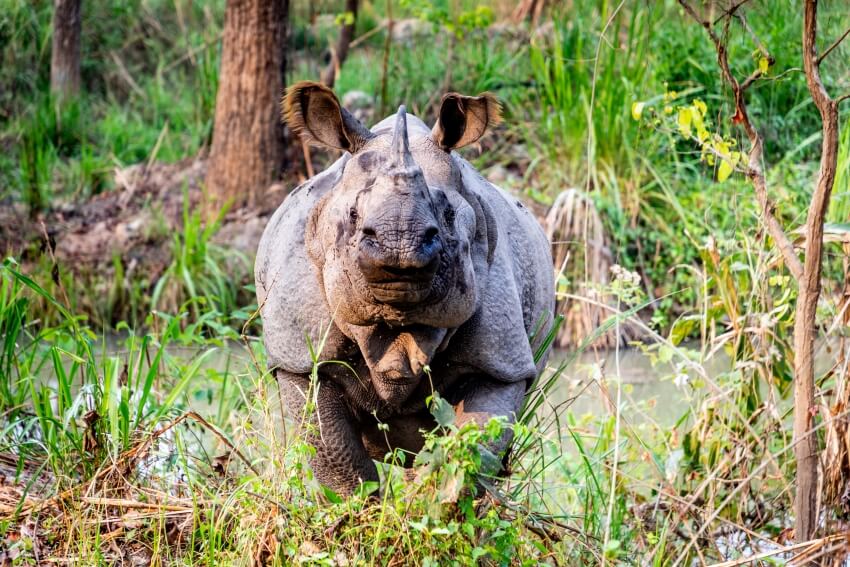
The rarest of the rhino genus is only plant in a single national park in Indonesia. They're primarily solitary creatures that alive in the lowland rainforests of Indonesia. Today, their main threat is poaching, though their numbers showtime dwindled considering of habitat loss due to logging.
Though the population there has by and large stabilized, it has been slow to increase despite conservation efforts. They reproduce slowly, with females giving nascency merely in one case every iv to five years. Their small population size makes them particularly vulnerable to disease.
The Javan rhino is not all the same extinct; though its numbers are so low, it's almost incommunicable to excogitate of the species making a improvement. The last localized population in Vietnam went extinct in 2010, and fewer than 75 adults are living in the wild today.
Run into Related: Black Rhino
12. Mount Glorious Torrent Frog (Taudactylus diurnus)
This species of tree frog native to Queensland, Commonwealth of australia, was first discovered in 1966 and last seen in the wild in 1979. Though information technology was abundant when start discovered, it declined rapidly and was soon declared Endangered, and Critically Endangered species presently after.
Many threats contributed to the amphibians' precipitous population plummet, from habitat loss due to logging, mining, tourism, and water management combined with water contamination to invasive species and diseases that completely wiped out the Mount Glorious torrent frog.
Although it hadn't been seen in decades, scientists continued to try to locate members of the species until 2004, when it was finally alleged extinct.
13. Spix'south Macaw (Cyanopsitta spixii)
The Spix's macaw was made famous in the blithe film Rio, where the master character gear up off to Brazil looking for the last wild member of his species. Nevertheless, by the time that motion-picture show was released, Spix's macaws had been lost in the wild for more than than ten years.
These beautiful blue birds were captured and traded as pets for decades, decimating their numbers as humans destroyed their habitats for agriculture and energy product. At that place are still many living in captivity, as pets, and in conservation programs.
Currently, a colony of convict Spix'south macaws is being prepared for release in the wild in hopes of reintroducing the species. Two conservation areas have been prepared specifically for their release, and scientists are hopeful that the program will succeed.
Related Resouces
- Best Conservation Books To Read
- Ways to Save Animals Facing Extinction
- How Do Animals Adapt to Their Environment?
Source: https://www.ourendangeredworld.com/species/animals-that-have-gone-extinct-due-to-deforestation/
Posted by: estradasoffew.blogspot.com
0 Response to "What Are The Animals That Are Going Extinct"
Post a Comment